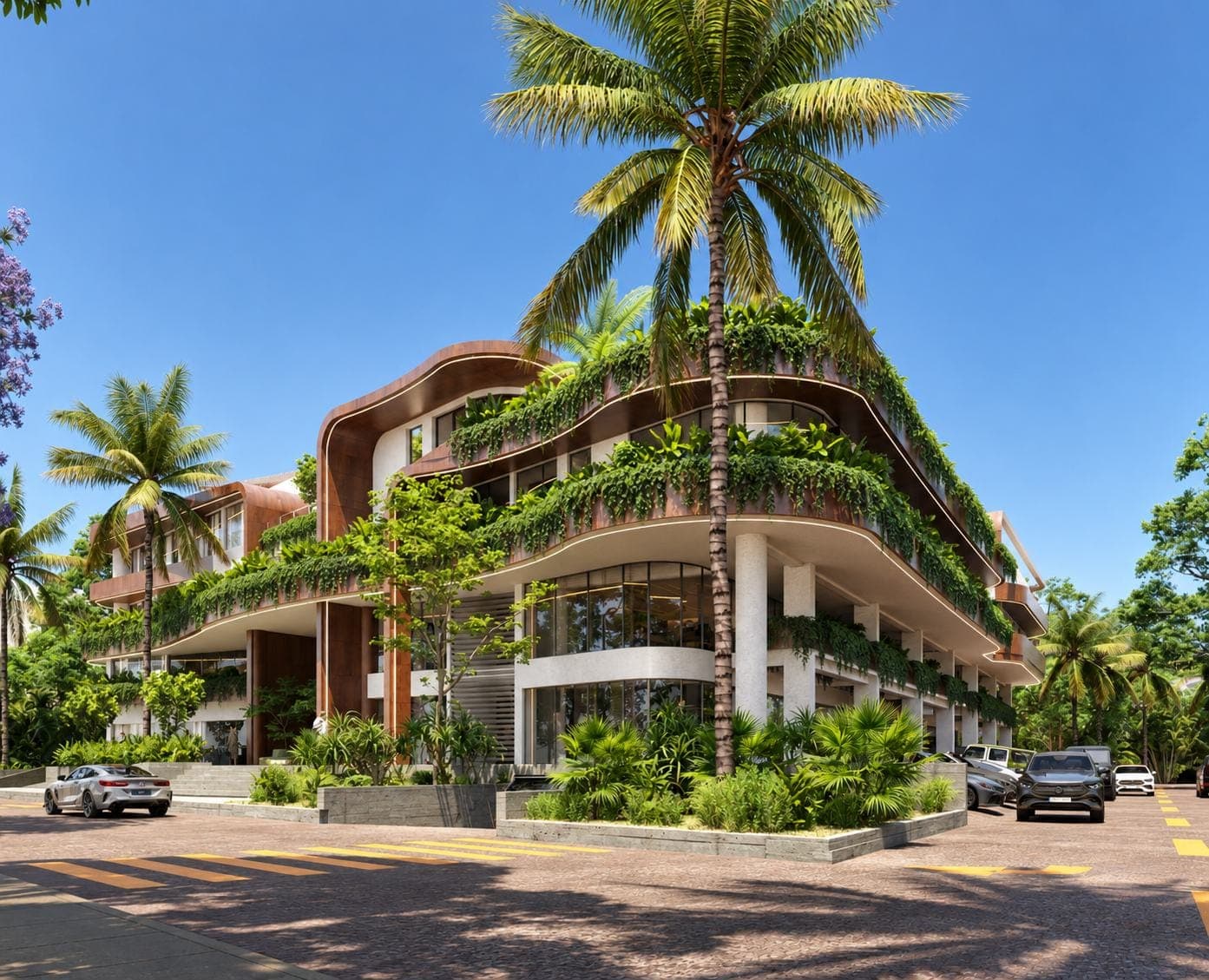
Photos of the development
Off-plan · Dominican Republic
Urban lifestyle complex in central Las Terrenas
New build · Q4 2028
Online viewing · remote deal
Crypto payment accepted
≈ €140,000

A foreigner owns property on the same terms as a citizen, with no residency or permit. Resort projects with CONFOTUR tax incentives, and residency from a US$200,000 real-estate investment.
Foreigners own property on the same terms as Dominicans: no residency, no permit and no local partner.
About 11.2 million visitors in 2024 and about 11.6 million in 2025, according to the country's tourism ministry.
Exemption from the 3% transfer tax and IPI for up to 15 years, but only if the project is approved and a resolution confirms it.
A real-estate investment from US$200,000 is grounds to apply; the funds must be transferred from abroad and certified.
The first 60 metres from the high-tide line are public land and cannot be bought; the border zone has special requirements. We check title and trust before any deposit.
Tell us the amount and the goal, and we'll come back with options from developers and partners that are not in the catalogue.
Send a requestThe 3 most affordable of 0
Photos of the development
Off-plan · Dominican Republic
New build · Q4 2028
Online viewing · remote deal
Crypto payment accepted

Photos of the development
Off-plan · Dominican Republic
New build · Q2 2027
Online viewing · remote deal
Crypto payment accepted

Photos of the development
Off-plan · Dominican Republic
New build · Q4 2027
Online viewing · remote deal
Crypto payment accepted
Holiday use, income or residency, budget, ready or under construction.
The developer, the trust under Law 189-11, the CONFOTUR resolution and the operator.
A promesa de venta with a notary or lawyer, the deposit in a lawyer's or escrow account.
We sign the contract before a notary.
DGII valuation, the transfer tax and the filing with the registry.
We collect the certificate of title and help with management and, if you wish, the residency application.
Yes. Foreigners own property on the same terms as citizens: no residency, no special permit and no local partner are needed, and the certificate of title is issued in your name. The exceptions are the first 60 metres from the high-tide line (public land) and the border zone, which has special requirements.
CONFOTUR (Law 158-01) gives approved tourism projects exemptions, including from the 3% transfer tax and the annual IPI, for up to 15 years. It does not apply automatically: the project must be approved by the tourism ministry, you must get the resolution number from the seller and have a lawyer check it, and on resale the benefit does not pass to the next buyer on its own.
The buyer pays a 3% transfer tax (not levied in CONFOTUR projects). Lawyers estimate their fee at 1–1.5% and the notary at about 0.5%, so closing usually costs 4.5–5.5% of the price. IPI is paid annually: 1% of value above the threshold (RD$10,695,494 in 2026).
Not by itself. But a real-estate investment of US$200,000 or more is grounds to apply for permanent residency through the migration service; the funds must be transferred from abroad and certified. Residency is not required to buy.
The main mechanism is a trust under Law 189-11: buyers' payments go to a trustee, not the developer's account, and are released as work progresses. Not every project is built through a trust, so we ask for the contract and confirmation before any deposit.
Sometimes. According to industry sources, local banks lend non-residents 50–70% of value over 10–20 years with 30–50% down; rates on US-dollar loans were around 8–10% in early 2026. Terms depend on the bank, your income and the property.

CONFOTUR, the trust behind off-plan payments, the operator contract, fees, exit and title: a checklist with the risks stated plainly.
Who can buy, the steps from promise of sale to title, what closing costs, the 2026 tax changes and where the limits are.
The Dominican Republic is one of the Caribbean's largest tourist markets: according to the country's tourism ministry about 11.2 million people visited in 2024 and about 11.6 million in 2025. A buyer from abroad registers title in their own name, and much of the new supply is resort complexes and residences managed by hotel operators and sold off plan.
Three reasons buyers from Europe and the CIS look here. The same rights as citizens. Foreigners, resident or not, own property on the same terms as Dominicans: no residency, no special permit, no local partner. You can sign while in the country on a tourist entry, and the certificate of title is issued in your name. Tourist demand. The country welcomes more than 11 million visitors a year, and that flow drives the resort-property market: rental income and resale depend on season, location and operator, so we look at the specific project rather than a country average. Tax incentives for approved tourism projects (CONFOTUR) and a route to residency: a real-estate investment from US$200,000 entitles you to apply for permanent residency. Both work only when their conditions are met, and we state them plainly below.
Benchmarks for taxes, purchase and holding costs and rental yield. Exact figures depend on the property and your situation.
Transfer tax of 3% is paid by the buyer. Annual IPI is 1% of value above a threshold (RD$10,695,494 in 2026). For individuals, gains on a property sale are taxed at 10% (Law 30-26). Projects approved under CONFOTUR are exempt from transfer tax and IPI.
On purchase: — transfer tax: 3% of the higher of the tax authority's valuation and the contract price; paid by the buyer; not levied in CONFOTUR projects; — lawyer: lawyers estimate 1–1.5% of the price; notary about 0.5%; with the tax, closing usually costs 4.5–5.5%. While you own: — annual IPI: 1% of value above the threshold (RD$10,695,494 in 2026, indexed every year); paid in two parts, by 11 March and 11 September; property in CONFOTUR projects is exempt; — rental income is taxable; according to advisers a 27% withholding applies to non-residents, so confirm the rate and base with a tax adviser; — service charges for the complex and the operator's management fees. On sale: — for individuals, a gain on selling property is taxed at 10% as a single payment (Law 30-26, from 18 June 2026), with exceptions for a main home and sellers over 65; the taxable base has not yet been defined by regulation, which is priced into deals.
1. Legal due diligence. Owner, encumbrances, land status. For projects under construction: the developer, permits, the payment schedule, and whether buyers' money passes through a trustee. 2. A preliminary contract (promesa de venta) with a notary or lawyer, and a deposit. Lawyers' practice is a deposit of about 10% held in the lawyer's or an escrow account; that is custom, not a statutory rule. 3. The sale contract before a notary. Notaries in the Dominican Republic are lawyers by training. 4. Valuation by the tax authority (DGII) and payment of the 3% transfer tax. The buyer pays it, and the registry will not issue the title without it. 5. Filing with the Title Registry (Registro de Títulos, Property Registry Law 108-05). 6. Receiving the certificate of title (certificado de título) in your name. From an accepted offer to the certificate usually takes 30 to 120 days.
Local banks typically lend non-residents 50–70% of value (30–50% down) over 10–20 years; rates on US-dollar loans were around 8–10% in early 2026. This is an industry estimate; terms depend on the bank and your income.
Buying property does not by itself give residency. But a real-estate investment of US$200,000 or more is grounds to apply for permanent residency (Regulation 631-11, art. 55): the funds must be transferred from abroad and certified, and the application goes to the migration service (DGM). Lawyers put the procedure at roughly 45–90 days; a spouse and minor children are included in the application. Residency is not needed to buy. It matters if you want to live in the country, and then the US$200,000 threshold should shape your budget.
The market is open in two formats: ready property and projects under construction with instalments through the build. Most new resort supply is complexes and residences managed by international hotel operators. What we check before showing a project: the developer, whether buyers' money sits in a trust (Law 189-11, payments released as construction progresses), whether the project holds a CONFOTUR resolution and what exactly it covers, the operator agreement and the service charges. We do not promise yield: it depends on the project, occupancy and management costs, and figures in developer presentations are expectations, not guarantees.
What to keep in mind: — CONFOTUR benefits apply only to projects approved in advance by the tourism ministry; get the resolution number from the seller and have a lawyer check it in the registry. On resale the benefit does not automatically pass to the next buyer. Sources differ on when the 15 years start: Law 195-13 ties the period to completion of the project's construction and fit-out, so confirm it against the specific project's resolution. Law 30-26 also introduced a bar on using more than one incentive regime for the same activity; how that works in practice is not yet clear; — the first 60 metres from the high-tide line are public land (Law 305 of 1968, Constitution art. 15): the beach and land in that strip cannot be bought; the border zone (within 60 km of the Haitian border) has special requirements for land deals; — a property under construction carries delivery and quality risk: check that payments run through a trust and are tied to construction stages; — the 2026 tax reform changes the regime for sales and is still being clarified by the tax authority: Law 30-26 did not expressly repeal the 3% transfer tax, but how it sits with the new rules is for DGII to explain; — a non-resident mortgage means 30–50% of your own funds and a higher rate than residents get; — expected yield and price growth in developer presentations are not a guarantee. Facts checked in October 2026. The tax reform (Law 30-26 of 18 June 2026) is only beginning to apply and the tax authority is still clarifying parts of it; thresholds, rates and programme terms change — confirm them with a Dominican lawyer before you sign.
Figures are indicative, change over time and depend on the specific property and your circumstances. Obtain independent legal, tax and financial advice before any purchase.
Tell us your goal and budget — we'll send a curated selection from trusted local partners, with no obligation.