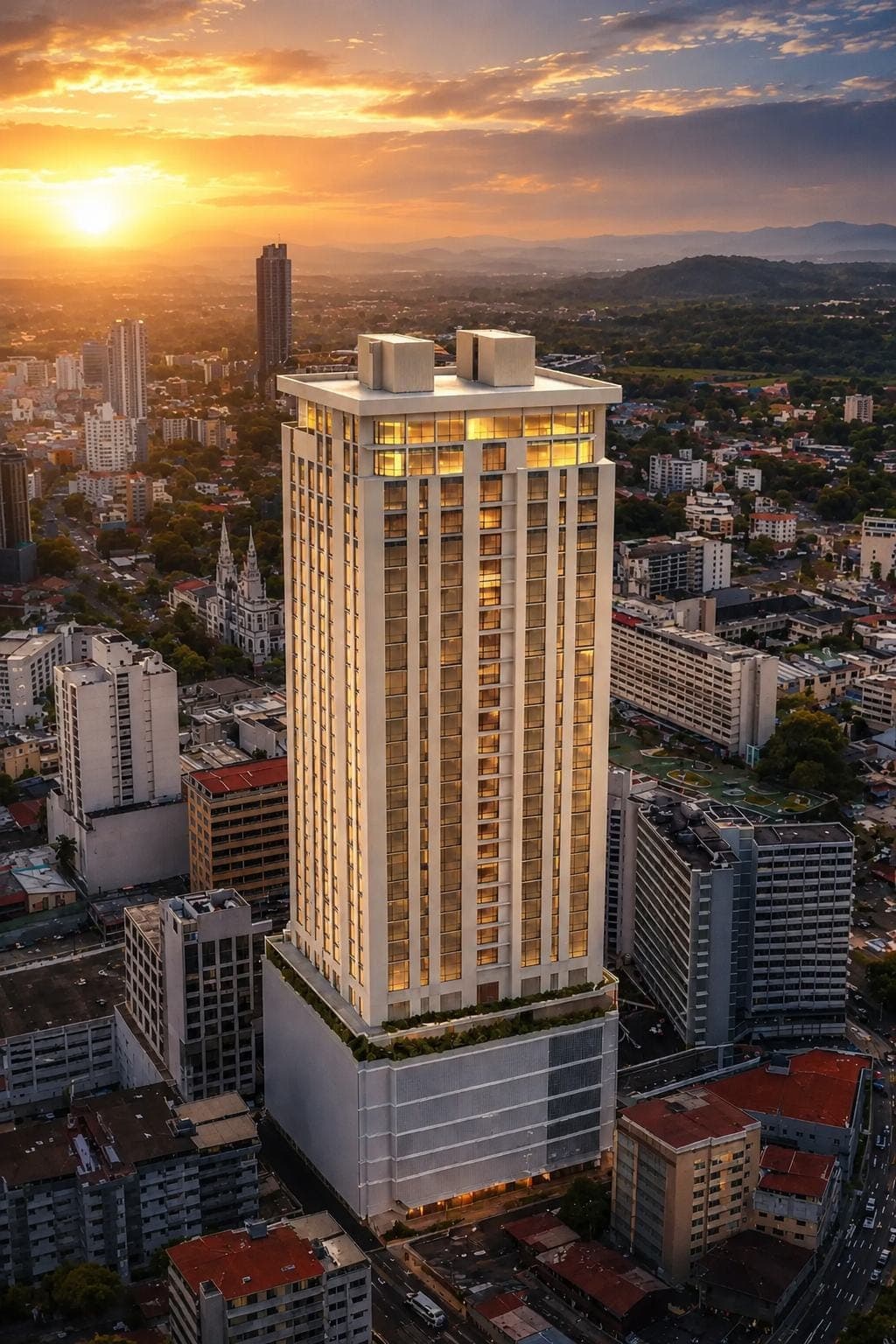
Photos of the development
Under construction · Panama
5-star Accor hotel in central Panama City
New build · 2027
Online viewing · remote deal
Crypto payment accepted
≈ €300,000

Foreigners buy in their own name without a residence permit, and an investment in new housing from $300,000 earns permanent residency. The programme's rules changed in September 2026; here is how.
Under the Qualified Investor programme, a new first-sale property of $300,000 qualifies for permanent residency; the resale market starts at $500,000 since 16 September 2026. The investment is held for five years.
Panama taxes only income earned inside the country. Your obligations in your country of tax residence remain, so check them before you plan around this.
Titled property can be registered in your own name or a company's, with no residence permit. The exception is a 10-kilometre strip along the land borders with Costa Rica and Colombia.
Since 1 September 2026 the first $120,000 of a first sale of a new home is exempt from the 2% transfer tax, with a reduced scale up to $200,000. The seller bears the tax.
Rights of possession (ROP) are not registered and cannot be mortgaged. For residency on an off-plan purchase, the programme requires 100% paid against an irrevocable bank guarantee or a trust.
Tell us the amount and the goal, and we'll come back with options from developers and partners that are not in the catalogue.
Send a requestThe most affordable of 0
Photos of the development
Under construction · Panama
New build · 2027
Online viewing · remote deal
Crypto payment accepted
Residency or income, new build or resale, and budget against the $300,000 and $500,000 thresholds.
Only property recorded in the Public Registry, with the developer and, for hotel units, the management terms reviewed.
A promesa de compraventa with a deposit of about 10%, drawn up with a Panamanian lawyer.
Title, cadastre, taxes, utilities and encumbrances; for residency, the qualifying value and the payment structure.
The public deed before a notary, then registration at the Registro Público; typically 30–60 days in total.
The investment certificate and residency application, then the annual proof and, if you rent the property out, management and tax set-up.
Yes. A foreigner, including a non-resident, can buy titled property in their own name or a company's with the same rights as a citizen. The exceptions: you cannot buy within 10 kilometres of the borders with Costa Rica and Colombia, and ownership of islands is restricted.
Under Decree 17 of 8 September 2026: $300,000 for new first-sale housing and $500,000 for the resale market. A fixed-term deposit in a state bank or securities also start at $500,000, and a deposit in a private bank at $750,000. The investment must be held for five years.
Not automatically. On the off-plan purchase-promise route, 100% of the amount must be paid to the developer against an irrevocable bank guarantee, or placed in a trust. Check the developer's payment schedule against that rule before signing.
For residency, the migration authority may cancel it if you are away for more than two years without a justified reason. Citizenship by naturalization is possible five years after the permanent-residency decision, with Spanish, a history and civil-rights test and presidential approval. Ask a lawyer about physical-presence requirements.
The 2% ITBI is normally paid by the seller. The buyer pays the lawyer, notary and registration, about 2–5% in total when buying with cash. After that comes annual property tax with a tax-free threshold. Foreign-source income is not taxed in Panama.
It is a right to occupy land without full title. The registry does not record it, the property cannot be mortgaged and disputes between claimants are common. For an investment or residency, choose titled property.

The September 2026 decree split the property threshold into $300,000 and $500,000. What the programme really requires, how off-plan and hotel units fit, and the questions to ask first.
Who may buy, why titled property matters, the six steps of a purchase, the real closing costs and the transfer-tax change that took effect in September 2026.
Panama has a dollarised economy, a territorial tax system and one of the most open property laws for foreigners in Latin America. A buyer can be a non-resident, and the owner can be a person or a company. The market splits between Panama City's high-rise towers and the Pacific and Caribbean resort coasts, and the central question in every purchase is a clean title.
Three reasons investors from Europe and the CIS come here. Foreigners own on equal terms with citizens. Titled property can be registered in your own name or a company's, with no residence permit. The one notable exception: you cannot buy within 10 kilometres of the land borders with Costa Rica and Colombia. Permanent residency through investment. Under the Qualified Investor programme, a new first-sale property of $300,000 or more qualifies for permanent residency. Since 16 September 2026 the threshold for the resale market is $500,000. You must hold the investment for five years and prove it every year. Territorial taxation. Panama taxes only income earned in Panama. Foreign-source income is not taxed in Panama itself. Your tax obligations in your country of tax residence remain.
Benchmarks for taxes, purchase and holding costs and rental yield. Exact figures depend on the property and your situation.
Transfer tax (ITBI) is 2% and is paid by the seller; since September 2026 the first $120,000 of a first sale of a new home is exempt. Annual property tax starts at 0.5% for a primary home and 0.6% for other property, with a tax-free threshold. Foreign-source income is not taxed in Panama.
A buyer's closing costs are roughly 2–5% when paying cash and 3–7% with a mortgage (lawyer, notary, registration). The ITBI transfer tax is 2% of the higher of the price and the cadastral value and normally falls on the seller. Law 546 of 31 August 2026 (in force 1 September) exempts the first $120,000 from ITBI on a first sale of a new home and sets a reduced scale up to $200,000 (0.5% to 1.8%). Condition: the sale closes within two years of the occupancy permit. The seller pays capital gains tax: 3% of the higher value as an advance, or 10% of the net gain. Annual property tax on a primary home: the first $120,000 is exempt, then 0.5% up to $250,000 and 0.7% above. On other property: up to $30,000 exempt, 0.6% up to $250,000, 0.8% up to $500,000 and 1% above. It is paid in three instalments a year. New housing enjoys multi-year relief that depends on the type of property.
Six steps to buy. 1. Choose titled property. The registry records only titled property; rights of possession (ROP) are not recorded. 2. Sign a promise to buy and sell (promesa de compraventa) and pay a deposit, usually about 10%. 3. A lawyer checks the title, cadastral maps, tax payments, utility bills and encumbrances. 4. The public deed (escritura pública) is signed before a notary and funds move as the contract says. 5. The deed is registered at the Public Registry (Registro Público). 6. If you want residency, you apply for the investment certificate and then for residency status. A purchase typically takes 30–60 days.
Banks typically lend non-residents 50–70% of value for up to 15–20 years, with rates for foreigners indicatively 7–9%; approval takes 2–8 weeks after a full file.
The Qualified Investor programme (Executive Decree 17 of 8 September 2026, in force since 16 September) grants permanent residency at once, with no provisional status. Thresholds: $300,000 for new first-sale real estate and for a purchase promise on an off-plan project; $500,000 for secondary-market property, securities and a fixed-term deposit in a state bank; $750,000 for a deposit in a private bank. The investment must be held for five years and proven annually, and the funds must come from abroad. Processing takes about 15 business days for the investment certificate and 30 business days for residency. Citizenship by naturalization is possible five years after the permanent-residency decision, with Spanish, a history and civics test and presidential approval.
For an investor the market splits into city, resort and hotel property. Income earned in Panama is taxed on a progressive scale: 0% up to B/.11,000, 15% up to B/.50,000 and 25% above. Ask a Panamanian tax adviser how rent on your particular property is taxed. Project yields are always a forecast by the developer or operator. Ask for the management contract, its term, the fees and how income is calculated.
Title. Buy only titled property recorded in the Public Registry. Rights of possession (ROP) do not give ownership, cannot be mortgaged and have no central database. Off-plan purchases. For investment residency on an off-plan purchase under a purchase promise, 100% must be paid to the developer against an irrevocable bank guarantee for the full amount, or held in a trust. A normal schedule of a down payment and a balance at handover does not automatically meet that requirement. Valuation. The qualifying value is the lower of the price and a reasonable market value, net of encumbrances. A price just above the threshold can be valued below it. Keeping residency. The migration authority may cancel residency if you are absent from the country for more than two years without a justified, authorised reason. Rules change. The programme's threshold was revised in 2020, 2022, 2024 and 2026.
Figures are indicative, change over time and depend on the specific property and your circumstances. Obtain independent legal, tax and financial advice before any purchase.
Tell us your goal and budget — we'll send a curated selection from trusted local partners, with no obligation.